by Ron Anahaw
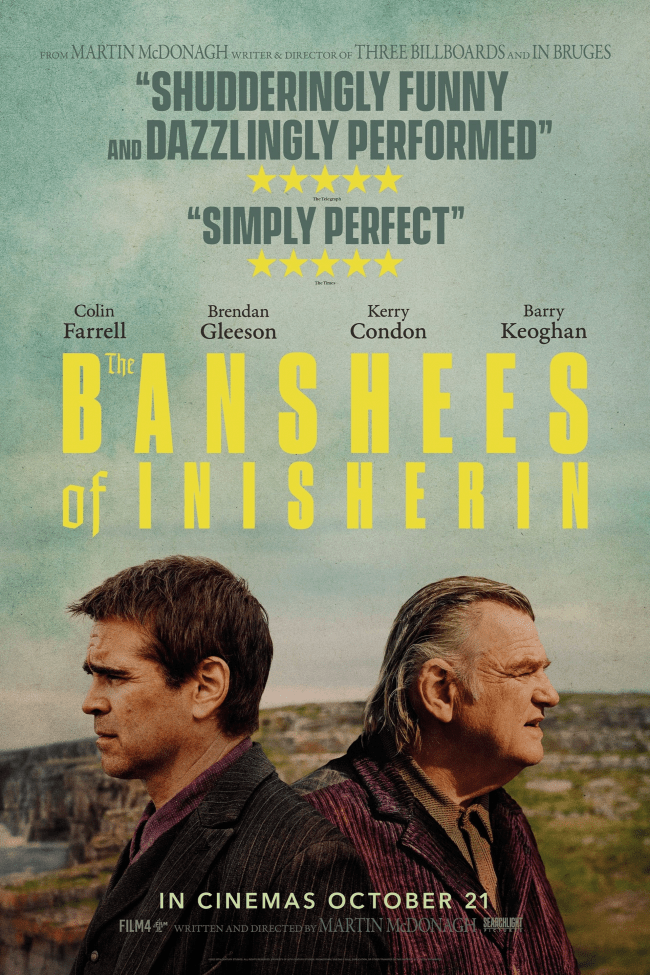
No one writes about dreary European violence better than Martin McDonagh. That’s a sincere compliment. I’m a big fan of his work, from his films (In Bruges, Seven Psychopaths) to his stageplays (The Pillowman, The Beauty Queen of Leenane). In his work, violence spills out from complicated characters struggling to make sense of a complicated world. It’s never so simple as “good guy shoot bad guy” and “bad guy shoot good guy.”
In the case of The Banshees of Inisherin, it’s “man cuts off own fingers to convince his former best friend to stop talking to him.” Yeah. Wild, right? Colin Farrell as Padraic and Brendan Gleeson as Colm play two former best friends in 1920s Ireland. Padraic is displeased to one day discover that Colm has decided that he just doesn’t like him anymore. Padraic just doesn’t get it. Colm’s feelings are much deeper than a decision made on a whim, but it’s puzzling all the same to Padraic. Colm is so done with Padraic’s “dullness” that after Padraic’s repeated attempts to reconcile with Colm, he threatens to cut off his own fingers and give them to Padraic if he’s not left alone. Absolutely. Nuts.
Meanwhile, Kerry Condon plays Siobhan, an intellectual stuck on an island of “boring men,” and sister to Padraic, and Barry Keoghan plays the Inisherin “gom” (slang for idiot? I’m not sure) who is abused by his policeman father.
There’s a pervading sense that not a single one of these characters is able to get what they really want on Inisherin, which makes it feel less like an island and more like purgatory. The thrust of the film is Padraic’s unrelenting desire to patch things up with Colm, who in turn, will stop at nothing to stop Padraic from bothering him with his dullness. This is all against a backdrop of the Irish Civil War, so one can surmise that Padraic and Colm’s dynamic is a metaphor for the conflict. As someone who’s woefully uninformed to that history, the film was…fine. The performances are well done, especially by Condon and Farrell, and the shots are simply gorgeous. But for me, Banshees doesn’t approach that same dread, that same tension, that same satisfaction, as something like McDonagh’s Pillowman or In Bruges. It feels like an allegory dressed up as a dark comedy instead of an allegorical dark comedy.
The film balances long, lonely shots of Inisherin with the gruesome: Colm hurling his severed fingers at Padraic’s door, or Dominic being beaten black and blue by his father. Padraic’s earnest “dullness” eventually gives way to vengeance after his precious pet miniature donkey dies from attempting to eat one of Colm’s fingers.
As I told a friend, the movie is memorable. And by no means is it bad. I just think I wasn’t the audience for it. Siobhan’s arc spoke to me the most in the film. Though she yearns for more from life, she feels somewhat tethered to Inisherin, mostly in part to her brother. But through a combination of being offered a job on the mainland, and the ever-increasing absurdity of the conflict between Padraic and Colm, she musters the courage to leave. As a viewer, I breathed a sigh of relief and thought, “Good for you, Siobhan. I don’t much want to be on Inisherin anymore either.”
SCORE: 66/120
| Enjoyment | Emotion | Aesthetic | Narrative |
| 6 | 6 | 8 | 6 |
| Cohesion | Originality | Execution | Impact |
| 6 | 8 | 7 | 3 |
| Ending | Rewatchability | Recommendability | Staying Power |
| 4 | 4 | 4 | 4 |
 Ron Anahaw